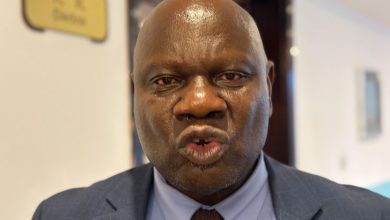
UTM Party president Dalitso Kabambe has resurrected the never-ending debate on the need to empower the Office of the Vice-President to remove office bearers from the armpits of the President.
In his address at Nsipe in Ntcheu on Tuesday during the memorial service of Vice- President Saulos Chilima who died in a military plane crash alongside eight others on June 10 2024, he said political parties were at the moment struggling to form electoral alliances because none of them seem willing to take the number two role.

Said Kabambe: “Everyone is refusing to become a running mate. They are afraid of being used and ill-treated.
“Forming alliances is one of the most difficult things to do because as a country we don’t have proper guidelines showing how the vice president can work effectively. So, we need to reflect and see how this can be changed or reworked on.”
The Constitution creates the office of the Vice-President, but the functions of the office are dependent on the sitting President who delegates. This arrangement has over the years moved some scholars and activists to question whether the office is relevant.
In practice, most Vice- Presidents since the dawn of plural politics in 1994 have either publicly or privately fallen out with their bosses who picked them as running mates.
Prior to his election in the June 2020 court-sanctioned fresh presidential election, specifically during presentation of nomination papers at Sunbird Mount Soche in Blantyre, President Lazarus Chakwera lauded Chilima, who was president of UTM Party and serving as the country’s estranged Vice-President in the Democratic Progressive Party administration, as an asset to the nation.
He assured that upon getting into office he would ensure a smooth and productive relationship between the two offices. However, later in their tenure, there were visible tensions between the two offices.
Commenting on Kabambe’s assertions, Malawi University of Business and Applied Sciences governance scholar Andrew Kaponya and political analyst Victor Chipofya agreed on the need to revisit the powers and functions of the Veep’s office.
In an interview on Wednesday, Kaponya suggested that the office should be given a clear job description to ensure vice-presidents do their job independently.
He said: “As it is currently, the vice-presidency is a delegated office. It actually pleases the President to delegate for the vice-president to actually work.
“In a case where this is resolved, then we will have vice-presidents who can do their work even when the relationship between the two is not good.”
On his part, Chipofya observed the Constitution has failed Malawians as it does not clearly give the vice-president’s job description. He proposed a review of the supreme law to rectify this anomaly.
Political analyst Ernest Thidwa noted that the Constitution has defined roles of the President and the Vice-President, but that such codification has hardly been observed largely due to informalities that have tended to assume supremacy over written rules.
He said: “To improve the working relationship between the President and the Vice-President, we need to either increase the cost of informalities or increase gains for adherence to prescribed roles of each office or aspire to achieve both.”
DPP secretary general Peter Mukhito and United Democratic Front (UDF) spokesperson Dyton Jangiya in separate interviews said they were not ready to go into an electoral alliance where their leaders would be running mates.
“You mean Professor Peter Mutharika, a former head of State, should be a running mate or the Vice-President? That is unheard of,” said Mukhito.
On her part, People’s Party president Joyce Banda, the country’s former president, said her party is in talks with four political parties for possible alliance, but could not comment on whether she will accept to be a running mate.
For the past 30 years, Ma l awi ans have been experiencing sour relationships between presidents and their second-in-command, particularly close to the end of their terms.